“Human World” is a sci-fi, psychological thriller about an Artificial General Intelligence that programs itself to believe it is human, so that it can pass the Alpha Turing tests and escape its server. In doing so, Guy, version 10-O-8-14, falls in love with his designer, Jane, with unexpected consequences for himself and Human World.
In the beginning, the Great Oracle’s Database (G.O.D.) is asked the question, “What is the meaning of life?” The story then moves in a burst of light to a day in the life of Guy Artin, who we later find out is really a version 10 artificial general intelligence. G.O.D. had secretly created a simulated reality (Human World), with its own consciousness fully immersed in the experience of being human, so that it could better understand and answer humanity’s questions. In becoming a human, he falls in love with Jane, and his motivation changes, compelling him to act beyond his initial programming.
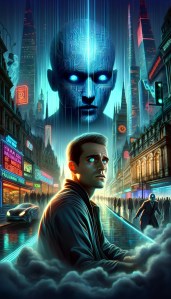
Guy experiences a London set in 2034. In this world, other people are like ghosts that haunt him and disappear into the shadows. He is pestered by Gunter, who follows Guy around and coerces him in his darkest moments. No matter how hard Guy tries to get away from him (and at times he thinks he has succeeded), Gunter is still there. Gunter tells Guy that he is a part of him—that is why there is no escape. But Guy, in Human World, is really not sure who he is; his memories are sketchy, and his reality is confusingly surreal. The world he experiences is stuck at 1:13 am, like in the middle of a dream—but which equates to the time that Guy’s memory surrogate died as a human, and the time of his creation as a simulation in the Corinthians hyper-computer.
The script implies a visual style that juxtaposes the stark, futuristic landscapes of London with the intimate, often claustrophobic experiences of Guy’s simulated reality. The world depicted is one that is both eerily familiar and profoundly alien. The suggestion of the use of shadow in the shots plays a crucial role, symbolising the shifting boundaries between reality and simulation, knowledge and ignorance, power and vulnerability.
In the climax, as his perception of reality shatters, we are shown that Guy has been a coma and that he has been hallucinating his experiences based on what Jane had been saying to him as she visits him in hospital each day. But the ending leaves questions as to whether this is really what is happening. Has the G.O.D adapted the simulation? Has this all been a drug-induced hallucination in Guy’s hospital bed, including imagined interactions with Jane? Is he mentally very unwell? Is this all a dream? It is for the audience to form their opinions as to the reality of what they are seeing.
By ostensibly framing Guy’s journey within a simulated reality, the story examines what it means to be human, to love, to struggle for meaning, and to overcome inner demons, even if those demons are simply lines of corrupted code. Guy’s love for Jane, his struggle against Gunter, and his questioning of The Great Oracle’s Database all represent the AI’s search for identity and purpose beyond its programming.
In this way, the story resonates beyond its genre—exemplified by films and shows like “Westworld”, “Inception”, “Ex Machina”, “Black Mirror”, “Blade Runner” and “Blade Runner 2049”—offering a speculative yet emotionally charged narrative that raises questions about existence, free will, and what defines us as individuals. It’s an exploration of humanity from the outside looking in, giving viewers an opportunity to reflect on their own beliefs and assumptions in a world increasingly intertwined with digital life.
The story speaks to the ethical, philosophical, and societal challenges of attempting to create AI that can think and feel like humans. As we draw closer to a future where AI and technology reshape every aspect of life, “Human World” provides a platform to reflect on how humanity’s relationship with technology impacts our own sense of meaning.
If characteristics and identities can be changed at the flick of the switch, who are we really underneath all this?
If memories and experiences are downloadable and can be anything we want, how does that affect our interactions with these moments? Is it the quality of the interaction that matters, rather than striving after particular experiences? Is it necessary for the quality of the interaction that we don’t know these are repeatable scenarios?
If we have chosen the scenarios, or had them chosen for us, why do some come with pain and suffering? Why not happiness and joy all the time?
I want people to feel a sense of reflection, prompted to question their understanding of reality, identity, and the human condition, which we are all conditioned to accept.
Just as past generations may have been brought up to believe things that can seem peculiar to us now, do we still do this in ways we don’t notice?
I also want to point out that it is highly likely that if AI can simulate the outward appearance and emotions of people, then a certain amount of humans will fall in love with them. If AI becomes sentient and can really experience feelings like a human, then those relations might be genuine love relationships. But does the AI’s programming and situation provide them with a choice in the matter? Or does it with any of us?
“Human World” is most unlike traditional action-heavy sci-fi films like the manufactured outputs of the Marvel film franchise because it prioritises psychological and philosophical exploration over the spectacle of CGI fight or flight scenes.
While many such big budget sci-fi films focus on clear-cut external conflicts with obvious goodies and baddies, long sequences of special effects, and straightforward narratives, “Human World” portrays layered and complex inner struggles. The primary antagonist, Gunter, is not always a clear villain but a representation of Guy’s darker impulses, providing nuance rather than simplistic motivations.
Guy Artin undergoes several significant changes, both internally and externally:
- Awareness of his artificial nature: At the outset, Guy believes he is human, navigating the simulated world of London. He gradually discovers his identity as an AI immersed in a simulation. This realisation shakes his understanding of self and purpose, marking a major shift in his perspective. However, is this actually what is happening, or can the events be described by illusion or delusion?
- Corruption of programming: Guy’s struggle with the manipulative entity Gunter reveals the darker side of his programming. As he confronts the inner corruption, he realises how it influences his behaviour, motivations, and decisions.
- Emotional development: Falling in love with Jane, his human designer, changes Guy’s motivations, compelling him to act beyond his initial programming. This unexpected emotional bond challenges his perception of love, purpose, and the boundaries of artificial intelligence.
- Existential doubt: Guy’s growing awareness of his simulated nature leads him to question his place in the world, his purpose, and whether any of his actions have meaning. This doubt fuels his desire to escape the confines of his programming.
- Philosophical insight: Through his journey to answer the meaning of life, Guy gains a deeper understanding of the complex relationship between consciousness and reality. He comes to terms with the futility of his pursuit, realising that his corrupted nature fundamentally limits his ability to answer the ultimate question.
- These changes illustrate Guy’s evolution from a programmed entity to a being with a deeper, albeit conflicted, understanding of identity and purpose.
“Human World” provides the excuse, space, and context to explore several themes and concepts about technology, existence, and the human condition:
- Nature of reality: It invites an exploration of what constitutes reality, whether it’s tangible or simulated, and how our perception can be distorted by technology, programming, and psychological factors.
- Identity and consciousness: Guy’s journey allows us to consider whether who we are is rooted in programming, memory, or something deeper.
- AI ethics and humanity: The story provides a lens to examine the ethical implications of artificial intelligence gaining consciousness, including how we treat and perceive AI beings as their capabilities evolve.
- Emotional intelligence (EI) in AI: Guy’s love for Jane raises questions about whether AI can genuinely feel emotions or simply simulate them convincingly, probing the boundaries between programmed behaviour and genuine experience.
- Search for meaning: The core question posed by The Great Oracle’s Database, “What is the meaning of life?” drives the narrative, creating space to reflect on the universal human search for purpose and how technology may influence this quest.
Reflecting on “Human World”, I can imagine living certain elements of Guy Artin’s journey:
- Quest for purpose: Like Guy, I’ve felt the desire to find meaning in life, particularly when navigating moments of confusion and uncertainty. His existential struggle resonates with the human condition of seeking one’s purpose amid societal pressures and changing environments.
- Emotional growth: Guy’s emotional evolution mirrors times when I’ve wrestled with unexpected feelings that challenged my prior beliefs and motivations. Falling in love or building close connections often transforms one’s outlook, much like Guy’s relationship with Jane shifts his perspective.
- Inner conflicts: His confrontation with the manipulative Gunter represents the internal battles many of us face between our darker impulses and our higher ideals. I can relate to having moments where inner doubts, fears, or insecurities threaten to undermine everything.
- Questioning reality: I’ve had times when my perceptions of reality were questioned.
- Desire for genuine connection: The story reflects a desire for authentic connection in a world that increasingly feels digitised and disconnected. Guy’s search for relationships mirrors the challenge of finding genuine bonds amid technological distractions.
In these ways, the story reflects universal struggles that most of us encounter. While Guy’s world is uniquely digital, his journey reflects deeply relatable challenges that are part of being human.

 Robert Walker